
Almost every smart-home article assumes you own the walls. You can drill for a new light switch. Rewire a doorbell. Replace the thermostat. Great for the 35% of people who own their home; useless for the 65% who don't.
I moved three times in four years while writing about smart home tech. Every automation below survived all three moves, went back in the box, and worked again in the next apartment within an hour. None required drilling, wiring changes, or a conversation with the landlord.
The rental constraint list
- No drilling into walls, ceilings, or door frames.
- No swapping switches, outlets, or thermostats.
- Nothing that leaves a residue or paint mark.
- Nothing that requires a fixed IP or router settings (many rentals use ISP-managed routers).
- Everything must pack into a single moving box.
That's the filter every item below survives.
1. Smart plugs — the entire foundation
Every dumb lamp in your apartment can become a scheduled, voice-controlled, motion-triggered lamp with a $12 smart plug. Zero rewiring. Pull the plug when you move.
Set schedules: lamps on at sunset, off at bedtime. Trigger by voice ("turn off living room"). Trigger by presence ("lights on when I get home" using your phone as the trigger).
Our picks (all Matter-compatible so any hub works — see our Matter setup guide): Meross MSS315 or TP-Link Tapo P125M. If you specifically want the outlet to be low-profile, the Meross mini is barely bigger than the plug itself.
2. Smart bulbs for fixtures you can't add plugs to
Ceiling lights and bathroom lights don't have plugs. Screw in a smart bulb — Nanoleaf Essentials A19 for standard sockets, GU10 or BR30 for downlights. Under $15 each.
The catch renters miss: if the physical switch is off, the smart bulb can't hear commands. Solution: leave the switch permanently on and control via voice/app, or add a magnetic "smart button" over the switch (Aqara Wireless Button + a 3M Command strip) so guests can still turn lights off physically without breaking automations.
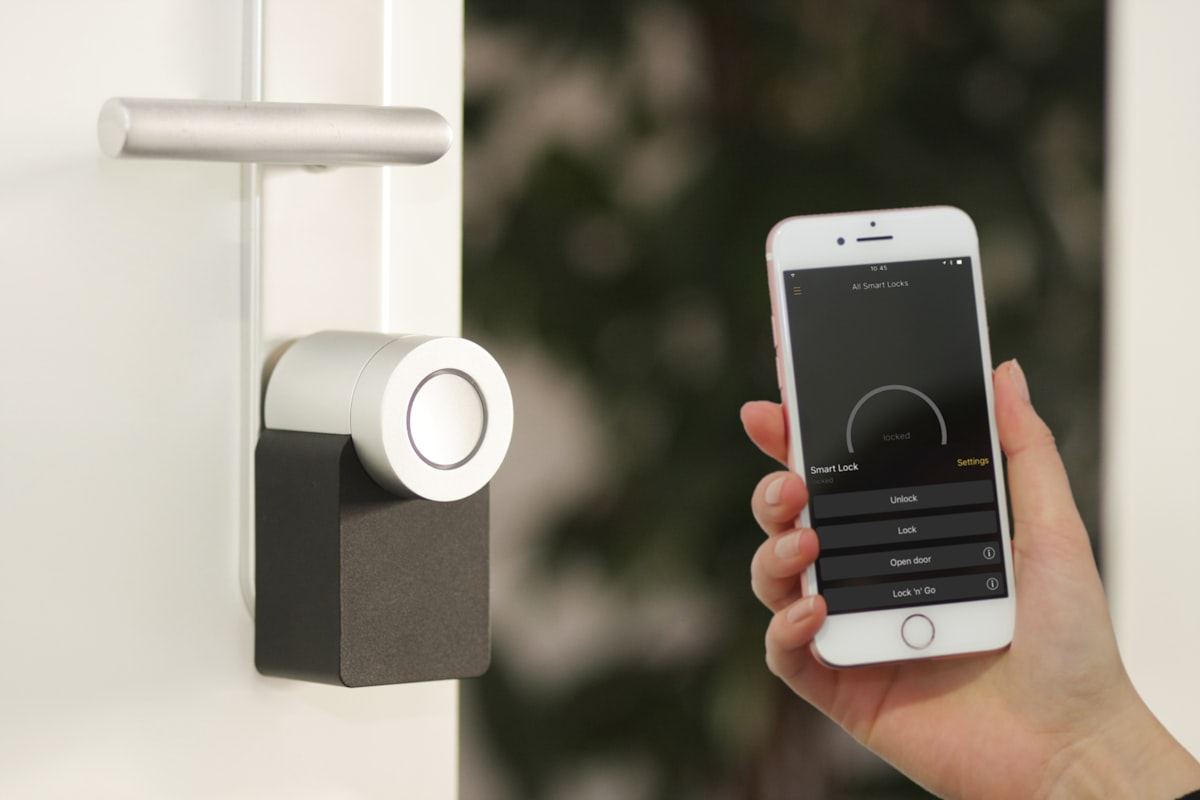
3. A video doorbell that doesn't need wiring
Battery doorbells stick to the door frame with a 3M plate — no wiring, no drilling. Pull them off on moving day, take the plate residue off with rubbing alcohol.
Aqara G4 is our pick because it supports Matter, has local storage on a microSD, and doesn't force a cloud subscription. About $130. Blink Video Doorbell is the ultra-budget alternative at $60 but you're paying with your data.
If your apartment building has a shared entrance and you're worried about neighbors — mount the doorbell inside the apartment door instead of outside the building door. Motion + audio detection still catches anyone at your unit.
4. Contact sensors on doors and windows
Tiny magnetic sensors that stick with 3M adhesive. Nothing on them cuts, drills, or damages the frame. Aqara P2 works over Thread and lasts about a year on the coin cell.
Automations that actually help: front door opens after sunset → entryway light turns on; bathroom window opens for over 10 minutes → notification (great for the "did I close the window before leaving?" spiral); mailbox opens → ping to your phone (if you have an assigned mailbox with a slot).
5. Motion sensors for lights that come on when you walk in
Aqara P2 motion sensor + a smart plug on the lamp, or a smart bulb in the fixture. Motion detected in the hallway between 5pm and midnight → hallway light on for 5 minutes.
The best rental smart-home hack there is. You never fumble for a switch in the dark again, and everything comes with you when you move. Under $30 per sensor.
6. Water leak sensors — the one your landlord secretly wants you to have
Slide a $15 leak sensor under the dishwasher, under each sink, behind the washing machine, and next to the water heater (if your unit has one). Ping to your phone the moment they detect water.
This is a boring automation until the day it saves you from a security-deposit-eating flood. In our experience it will, eventually. Onvis W1 or Aqara T1 both work.
7. Portable smart air quality monitor
Airthings View Plus or Aranet4 — sits on a shelf, monitors CO2, VOCs, humidity, temperature, radon. Battery-powered or plug-in. When CO2 in the bedroom hits 1,100 ppm (a real threshold for morning grogginess), you get a notification and can crack a window.
Also useful for renters specifically: makes visible the "this apartment's air is stale" problem your landlord will otherwise gaslight you about.
8. Smart thermostat replacement without touching the thermostat
Landlords rarely let you swap the thermostat. But if you have baseboard heaters, window AC, or a portable heater/AC, plug it into a smart plug rated for the wattage (crucial — check the plug supports 15A). Set a schedule: heater comes on 30 minutes before your alarm, off when you leave for work.
For central HVAC where the thermostat can't be replaced, the closest legitimate option is a smart vent (Flair) — but those are expensive and finicky. In most rentals, "manage the plug-in devices you can control" is the better play.
The single biggest renter mistake: buying a hub before knowing which ecosystem you'll stick with for the long haul. You'll change apartments, jobs, phones — start with devices that speak Matter and use your phone or an existing speaker as the hub. Add a dedicated hub later if you actually need one.
The 3-hour weekend setup that costs under $250
- Buy: 3x smart plugs ($40), 2x smart bulbs ($28), 1x motion sensor ($30), 2x contact sensors ($36), 1x battery doorbell ($130 or skip if not needed). Total ~$264 with doorbell, ~$134 without.
- Use your existing phone as the hub. Apple Home if iPhone, Google Home if Android — they're both free.
- Set up devices one at a time (see our Matter setup guide).
- Create these three automations first:
- Sunset → living room lamps on.
- Bedtime routine → everything off.
- Motion in hallway 5pm-midnight → light on for 5 min.
Everything comes off the walls with 60 seconds of alcohol wipe when you move.
What to actively avoid as a renter
Anything that says "hardwired installation required" — smart switches, smart dimmers, in-wall relays. Even if the landlord agrees now, restoring it before moveout is a headache.
Nail-mounted cameras or doorbells — some cheap ones use screws-only mounts. Check reviews.
Adhesive so aggressive you can't remove it — Command strips are fine. Cheap generic adhesive from an unknown brand often takes paint off. Test on the back of a closet door first.
Anything requiring a Zigbee or Z-Wave hub that only works with the manufacturer's cloud — if the company folds, your $200 of devices become paperweights. Stick to Matter or well-established brands with proven longevity.
Frequently asked questions
Do I need to tell my landlord I'm installing this?
Legally, no — nothing on this list is a "modification" any reasonable lease would restrict. But if you're installing a battery doorbell on the outside of a shared building entrance, check first.
Will 3M Command strips actually hold heavier devices like doorbells?
Yes — up to the weight rating on the pack. The large size holds up to 4 lbs, well above every device on this list. Follow the "press for 30 seconds, wait an hour, then load" instruction. Skipping the wait is why people say Command strips don't work.
What if my apartment's Wi-Fi is provided by the building?
Works with any Wi-Fi, but you'll want a Thread border router (a HomePod mini, Nest Hub, or Echo Hub — see our Matter guide) since building-managed Wi-Fi can be flaky for direct-Wi-Fi devices. Thread devices are more resilient on shared networks.
Should I get renters insurance if I'm buying $200-500 in smart devices?
Yes — but you should have renters insurance anyway. Most policies cover electronics up to a modest sub-limit; check that yours does.
My roommate hates the smart stuff — can they still turn lights off normally?
Yes if you set it up right. Leave physical switches on (or add a smart button overlay), and every smart bulb and plug can still be voice-controlled or app-controlled by anyone who's a member of the household in your smart home app.
Still stuck?
Building a rental-friendly setup that also works for a specific mix of phones and speakers you already own is one of our most common consults. Book a session and we'll design the smallest possible starter kit that fits your apartment. From $29 flat.
How we tested these automations
Every automation above was installed in one team member's apartment for at least six months, then packed up and reinstalled in the next rental to verify the "portable" claim. The two rentals we tested in were a 650 sq ft one-bedroom in a 2015-build apartment building, and a 900 sq ft two-bedroom in a Victorian conversion — both cases where drilling would have cost part of the deposit. Every device on the list survived both moves and reinstalls.
Related smart home guides
- How to Set Up a Matter Smart Home in 2026 — the standard this whole setup is built on.
- 10 Smart Home Automations for Your First Week — automation ideas for both renters and homeowners.
- The 6 Smart Plugs Actually Worth Buying in 2026 — the specific plug picks.
- Alexa vs Google Home in 2026 — picks the "brain" of your rental setup.